
Worth County Court Records After Arrest
Worth County court records after a jail arrest are different from the sheriff's booking file. A deputy, municipal officer, Missouri State Highway Patrol trooper, or outside warrant agency may make the arrest and bring the person to the local jail channel. The Worth County Sheriff's Office creates or keeps the arrest and booking records. The Worth County Prosecuting Attorney then reviews the reports and decides whether a criminal charge should be filed. Once the charge is filed in court, the case record can show the charge text, case number, bond order, hearings, warrants, docket entries, pleas, amendments, dismissals, judgment, sentence, probation, and final disposition.
The county jail side still matters. Current custody, release, transfer, and basic booking details belong with the sheriff or jail record. For that path, use the Worth County jail inmate records page. Booking photos are a separate records issue, and no official Worth County mugshot gallery was located, so photo questions fit the Worth County jail roster mugshots page. Court records after arrest are about the case that follows the booking. They show what the prosecutor filed, not just what an officer listed at intake.
Find Worth County Court Records
Missouri's public court search channel is Case.net. It is the practical first place to look after Worth County charges are filed. Case.net is a court portal, not a jail roster. It can help locate criminal case numbers, filed charges, scheduled hearings, bond entries, warrant-related docket entries, and dispositions. Automated court scraping is not appropriate; the public portal should be searched manually by a person using the search tools provided by the Missouri courts.
- Open Case.net and choose a search mode that fits the facts known, such as litigant name, case number, filing date, or scheduled hearings.
- Use the defendant's full legal name when no case number is known. Narrow to Worth County or the relevant Missouri court filter when the portal offers that option.
- Open the matching criminal case and read the docket, charge list, bond entries, hearing dates, and disposition fields carefully.
- Compare each court charge with any booking charge from the jail record, because the labels can differ after prosecutor review.
The Missouri courts county court data locator is useful for local court contact details when a public case search leaves a question. Worth County Circuit Court and the Circuit Clerk are listed at 11 West 4th Street or PO Box 350, Grant City, MO 64456. The researched phone number for the Circuit Clerk is 660-564-2210, with fax 660-564-3394. Clerks can answer records-process questions, but they cannot give legal advice about what a charge means or what a defendant should do.
| Case.net field | Type | Use |
|---|---|---|
| Litigant Name Search | Search mode | Use a defendant last name and first name when the case number is not known. |
| Case Number Search | Search mode | Best when a citation, warrant, or court case number is already known. |
| Filing Date Search | Search mode | Useful for recent filings by date range after a known arrest period. |
| Scheduled Hearings & Trials | Search mode | Useful to locate upcoming appearances tied to a defendant or case. |
| Court / County | Filter | Select Worth County or the relevant circuit when available to reduce false matches. |
| Track This Case | Action | Use for notifications where the Case.net feature is available. |
Charging Documents After Arrest
After a Worth County jail arrest, the charge record starts with a filing decision. The Worth County Prosecuting Attorney reviews police reports from the sheriff, a city officer, MSHP, or another agency. The prosecutor may decline charges, file a complaint, file an information, or use a grand-jury route when the law and facts call for it. Routine county prosecutions often proceed through prosecutor-filed documents. The key point is simple: the jail booking entry is not the final word on the court case.
| Document | Who files it | What it does |
|---|---|---|
| Complaint | Usually an officer or prosecutor | Starts a criminal case or sets out the initial allegation for court action. |
| Information | Prosecuting Attorney | States the formal charge filed by the prosecutor, often used in Missouri felony and misdemeanor practice. |
| Indictment | Grand jury | Starts a case through a grand-jury charge, often in more serious or specially handled matters. |
The prosecuting attorney office is a charging authority, not a jail records office. Research located the Worth County Prosecuting Attorney at PO Box 177, Grant City, MO 64456, phone 660-564-3535, fax 660-564-2272. The office reviews reports and appears in Worth County Circuit Court. Victim-related resources listed through the Missouri Department of Public Safety Worth County directory also identify prosecutor and sheriff contact blocks for the county.
Worth County Charge Status
Court records after a Worth County arrest should be read by count and by status. A case may have more than one count. One count may be pending while another is dismissed or amended. A charge can be reduced, replaced, added, dismissed, or resolved by plea or trial. A disposition is the court outcome. A conviction means a finding or admission of guilt. Neither an arrest nor a filed charge is the same thing as a conviction.
| Status | What it means in the court record |
|---|---|
| Pending | The count or case has not reached final court disposition. |
| Amended | The charge text, level, count, or other filing detail changed after the first filing. |
| Reduced | The prosecutor or court action changed the charge to a lower level or lesser offense. |
| Dismissed | The count or case was ended without a conviction on that charge. |
| Disposition | The final result, such as plea, judgment, dismissal, acquittal, sentence, or probation term. |
Missouri public-record law also affects what can be seen outside Case.net. RSMo 610.100 treats arrest and incident reports as open records, with exceptions and redactions. RSMo 610.105 can close certain records after qualifying final outcomes, including no charges, dismissal, or acquittal, subject to the statute's rules. That is why a court search, a sheriff request, and a later records-closure question may not produce the same public view.
Bond Records After Arrest
Worth County-specific online bond payment instructions were not located in official sources. The research-supported path is to call the Worth County Sheriff's Office, led by Sheriff Scott Sherer in the state law-enforcement directory, at 660-564-2222 and the Worth County Circuit Clerk at 660-564-2210 before trying to post money. The jail can often confirm custody and whether a detainee can be released from the jail side. The court controls legal release conditions, bond orders, and paperwork after a judge acts.
| Bond type | Practical meaning |
|---|---|
| Cash bond | The full amount is paid to secure release and appearance. Confirm the payable office and accepted method locally. |
| Surety bond | A licensed bail bond agent posts surety for a fee. Commercial bail exists in Missouri. |
| Personal recognizance | Release without upfront cash, based on a promise to appear and court conditions. |
| Property bond | Property is pledged as security, with local court requirements controlling the process. |
| No-bond hold | Release is blocked by a judge's order, outside warrant, parole or probation hold, federal hold, ICE detainer, or other authority. |
A Case.net docket may show first appearance, bond amount, bond conditions, bond forfeiture, or a warrant entry. The jail record may show that a person is held, released, or transferred. If posting one bond does not release the person, ask whether another agency hold exists. A detainer is a hold or notice from another jurisdiction or agency, and it can keep a person in custody even after the local Worth County charge has a bond option.
Worth County Warrant Records
No official Worth County public warrant list or warrant-search portal was located in the research. Warrant questions should start with the Worth County Sheriff's Office for local custody or service questions, then move to Case.net for court-filed criminal cases, failure-to-appear entries, bond forfeiture, and warrant-related docket notes. The Circuit Clerk can answer court-record process questions. If the warrant came from another county or state, the issuing court or agency controls that warrant, even if Worth County later holds the person after arrest.
Warrant terms matter. An arrest warrant authorizes an arrest on a criminal allegation or filed charge. A bench warrant is issued by a judge, often when a person fails to appear or fails to comply with a court order. A search warrant authorizes a search and is not the same as an inmate lookup record. A probation or parole warrant may produce a DOC hold. An out-of-county warrant can appear as a local hold after booking, but the other jurisdiction controls release terms.
Charges vs Convictions
Worth County court records after an arrest can show an allegation long before they show a final outcome. That distinction is vital for readers, employers, landlords, and family members. A charge is an accusation filed in court. It may be supported by probable cause, but it has not been proven at trial or admitted by plea. A conviction is a final criminal outcome based on a guilty plea, finding, or verdict. A dismissed charge is not a conviction.
| Point | Charge | Conviction |
|---|---|---|
| Stage | Accusation filed in court after arrest or prosecutor review. | Final result based on plea, finding, or verdict. |
| Proof level | Often tied to probable cause or filing standards. | Requires proof beyond a reasonable doubt or a valid guilty plea. |
| Case status | May be pending, amended, reduced, or dismissed. | Appears as part of the disposition or judgment. |
| Custody effect | May affect bond, warrants, and hearing dates. | May lead to sentence, probation, jail time, or Missouri DOC transfer. |
Sealed and Expunged Records
Missouri records can become less visible for more than one reason. Closure, sealing, and expungement are not the same thing. Under Missouri Sunshine Law, some arrest records may close after qualifying final dispositions, including cases where no charges are filed, charges are dismissed, or the person is acquitted. Other limits may apply to juvenile matters, active investigations, safety risks, confidential sources, or court orders. Public access can change after the first weeks of a case.
| Issue | Sealed or closed | Expunged |
|---|---|---|
| Public view | Hidden from ordinary public access or limited by statute or order. | Removed or treated under the specific expungement law that applies to the record. |
| Who may still see it | Courts, law enforcement, or listed agencies may retain limited access when law allows. | Access depends on the expungement statute and later legal exceptions. |
| How it happens | Can follow statutory closure rules or a court order. | Usually requires eligibility under Missouri law and a court process. |
| What to verify | Ask the court or record custodian whether the specific file is closed. | Confirm the order and which offices received it. |
A person trying to clear or limit a Worth County arrest or case record should not rely on a search result alone. The court file, sheriff's arrest record, prosecutor record, and state criminal-history systems may each have their own process. Legal advice should come from a Missouri lawyer or approved legal-help source, not from a public search result.
After Sentencing to Missouri DOC
If a Worth County defendant is sentenced to state prison or state supervision, custody tracking moves away from the county jail channel. The Missouri Department of Corrections Offender Web Search covers active offenders, including probationers and parolees, unless excluded for safety, security, or confidentiality. MODOC states that discharged offenders are not provided through that search. It is not a replacement for Case.net, because the DOC locator tracks state correctional custody and supervision rather than each court docket entry.
The Missouri DOC all-facilities list did not identify a state prison in Worth County. A local defendant who receives a prison sentence would leave the local jail system for DOC classification and placement elsewhere in Missouri. Federal cases follow a different path: the U.S. Marshals handle federal pretrial custody, and the BOP inmate locator becomes useful after federal commitment. Immigration custody is searched through ICE ODLS when the person is in ICE custody.
Case.net Court Search View
The manifest includes a captured source image from the Missouri Case.net public case search portal, the court-record access channel used for Worth County criminal cases after charges are filed.
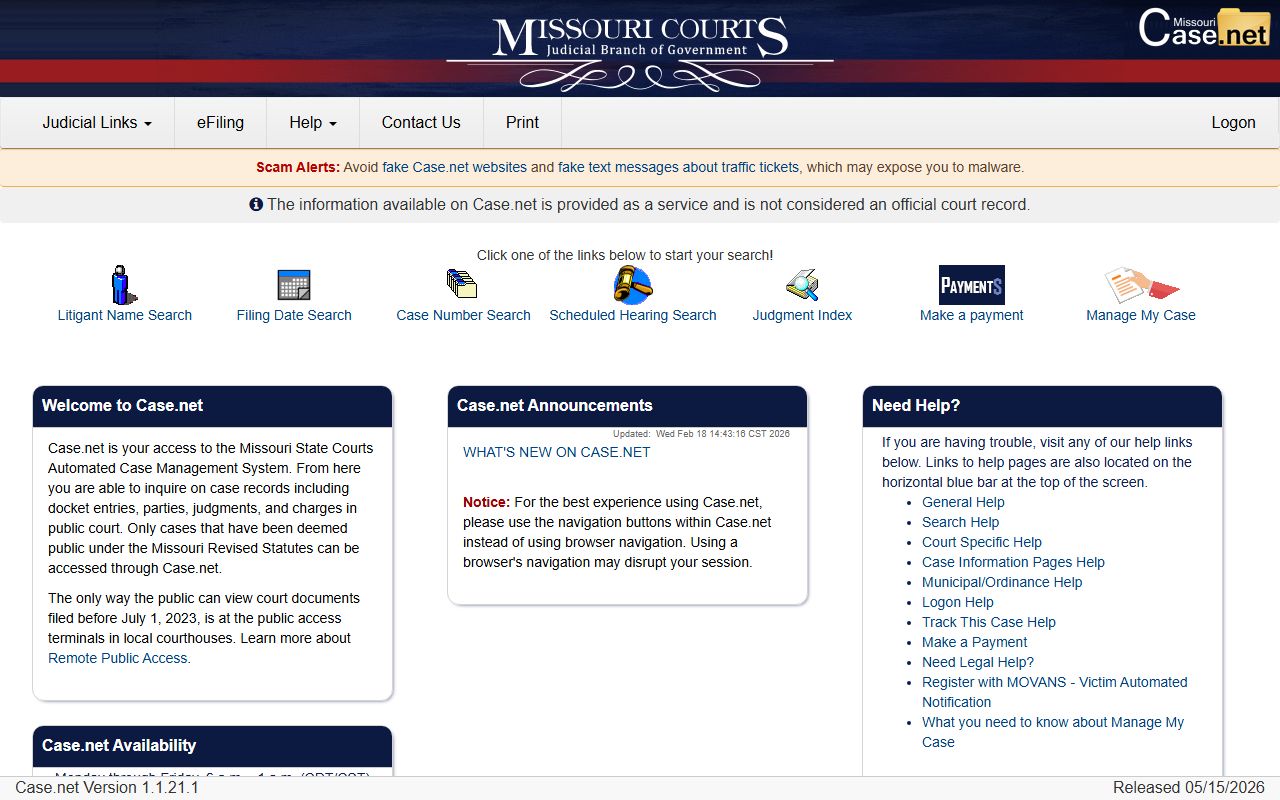
The portal image is included because the court search fields matter after a jail arrest. It supports manual lookup by name, case number, filing date, and hearing schedule, which are the search paths documented for the Worth County court-record workflow.
Restricted Worth County Court Records
Not every record tied to a Worth County arrest will remain open in the same way. Juvenile matters are often restricted. Active investigative records can be closed while the investigation remains active. Portions of law-enforcement records can be redacted when release would endanger a person, harm an investigation, reveal a confidential source, expose techniques, or fall under another listed exception. If a person is arrested and not charged within 30 days, Missouri law can change the public status of the arrest report except for disposition access and statutory exceptions.
For a record not found in Case.net, the best next step depends on which office holds it. Court filings and docket access questions belong with the Circuit Clerk. Booking, arrest, incident, and release-record questions usually begin with the Worth County Sheriff's Office as the custodian of the jail-side record. Sunshine Law requests should identify the person, arrest date, incident or case number if known, record type, and preferred format. Under RSMo 610.023, a public governmental body must act as soon as possible and no later than the end of the third business day, or explain why more time is needed.
Important: This site is not a consumer reporting agency, and its content may not be used for FCRA-covered screening decisions.